
|
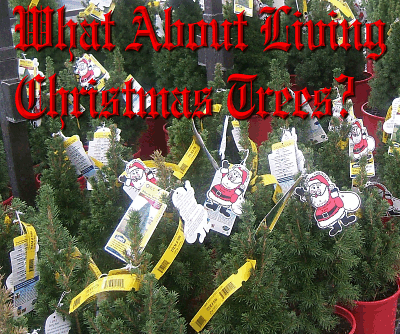
What About Living Christmas TreesWhat About Living Christmas Trees?Every year during the Christmas season, fans of growing things are tempted by little Christmas-tree looking conifers being sold in the store.
So, how do you give these things a chance at survival? Again, I hinted at it earlier. Once ANY tree has been subjected to a heavy frost or two, it starts to go dormant - even evergreens. Think of it as a sort of "hibernation." If you take ANY living thing that has been "hibernating" outdoors in freezing temperatures, then plop it into a warm living room, you'll put it into a shock from which it may not recover. That's why the directions for the big ($75-200) "Living Christmas Trees" tell you to spend two weeks gradually acclimating the tree to warmer temperatures. Then they tell you to leave the tree indoors for no more than three days. (The dry air in a heated house also stresses the plant, even if you keep the roots moist.) Finally, the instructions tell you to spend another two weeks gradually acclimating the tree to cooler temperatures before you stick it into the ground. This lets the tree start to go dormant again so it doesn't go into shock when it's exposed to very cold temperatures. This CAN be done. Some people do it every year. But if someone gave me $200 and told me I needed to spend it on a "Living Christmas Tree," I'd seriously consider spending $50 on a cut tree and spending the other $150 on a live tree to plant right into the ground - a year from now I'd still have the $150 tree at any rate, and if I didn't, at least I'd have a warranty on it, which you don't usually get on trees you use in your house. That said, the little Dwarf Alberta Spruce I saw at Lowes have a much shorter list of instructions, and I believe, a greater chance of survival, if you want to go that route. The instructions seem tailor-made for climates where it doesn't get REALLY cold In December, 2006, I saw several other varieties that were not dwarf trees, such as "Black Hills Spruce" sold the same way. My guess (based on experience with other trees) is that these are a little touchier than the Dwarf Albertas, but that they might survive if you're very careful. One variety that looked great was called a Lemon Cypress. Unfortunately, the label on that plant said it wouldn't survive below -10F, which rules it out as an outdoor plant for us. In other words, if you want to take a risk on a small "real live tree," read all of the instructions and disclaimers before you get it out of the store. But bringing a large (3' or more) live tree in and back out in midwinter is a huge risk that may not be worth taking unless, perhaps you have already started with smaller trees. Hope this makes sense; please contact us with any questions or suggestions. And have a great family Christmas Paul Race To return to the About Christmas Trees page, click here. To return to the Family Christmas OnlineTM Home Page, click here.
|


|
Note: Family Christmas OnlineTM is a trademark of Breakthrough Communications(tm) (www.btcomm.com).
All information, data, text, and illustrations on this web site are
Copyright (c) 2006, 2007 by Paul D. Race.
Reuse or republication without prior written permission is specifically
forbidden.
Family Christmas Online(tm) is a participant in the Amazon Services LLC Associates Program, an affiliate advertising program designed to provide a means for sites to earn advertising fees by advertising and linking to amazon.com.
For more information, please contact us
Counter Reset 12/08/2006

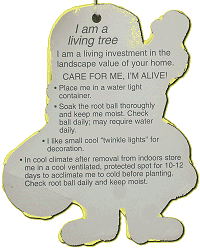 until after Christmas; they assume that the tree hasn't gone dormant before you bring it inside. You can't make that assumption, but you probably CAN find a microclimate somewhere on your grounds that will protect them from sub-freezing temperatures for a few weeks without exposing them directly to heated indoor air. If that is a place where they will get at least some light, there's no reason not to buy the little tree(s) now, so you have some control over what its/their exposure between now and Christmas. This way, you can spare the tree(s) the shock of being allowed to go dormant, then being forced out of and back into dormancy (is that a word?) within a six or eight week period. Be sure to keep them moist. If you want to set them outside on sunny days with mild temperatures, by all means do so. Just bring them in before the temperature drops below 40F or so. Because these trees haven't had a chance to go dormant, they will not be quite so "touchy" about a few days' exposure to heated indoor air. Keeping them watered is a must, though. Then, when the holidays are over, the rest of the process is the same - you move the trees gradually into progressively cooler temperatures until it is safe for them to go into the ground. When you plant them, though, do all the nice things for them you're supposed to do, including providing good planting soil and water.